Are Pokémon Cards From the 2000s Worth Anything?
Crystal cards, Gold Stars and LV.X hold real money from the 2000s. Ordinary Diamond & Pearl holos sell for under $15. Here is how to tell yours apart.
Some of them are worth a great deal. Most of them are worth almost nothing. The gap between those two groups is wider in the 2000s than in any other decade of Pokémon, and it does not follow the rules people expect — a shiny card is not the signal, and neither is age.
The short version: nine Crystal cards, 27 Gold Stars and a handful of LV.X cards carry the value of the entire decade. Everything else — the hundreds of ordinary holos filling most binders from this stretch — is worth single-digit to low double-digit dollars, and that is true no matter how mint it is.
Which sets count as the 2000s
Three distinct eras sit inside this decade and they behave very differently. Knowing which one a card belongs to tells you most of what you need before you look up a single price.
| Era | Sets | Years | Typical ordinary holo |
|---|---|---|---|
| e-Card | Expedition, Aquapolis, Skyridge | 2002-2003 | ~$15-$150 |
| EX | EX Ruby & Sapphire through EX Power Keepers | 2003-2007 | ~$6-$45 |
| Diamond & Pearl / Platinum | Diamond & Pearl through Arceus | 2007-2009 | ~$4-$20 |
The trend runs downhill through the decade. e-Card holos hold real money, EX-era holos hold some, and by Diamond & Pearl the ordinary holo is barely worth the postage to send it anywhere on its own. Our guide to card values by year covers how this pattern extends either side of the 2000s.
The e-Card era is the strongest part of the decade
Cards from Expedition, Aquapolis and Skyridge hold more value than anything else in the 2000s, including ordinary commons and uncommons. You can identify them instantly: they have a wide black-and-white striped strip along the bottom edge and up the left side. That is a dot code, printed to be swiped through a Nintendo e-Reader.
Expedition arrived in English on 15 September 2002 with 165 cards, and it was the first non-reprint English set with no 1st Edition print run. Aquapolis followed on 15 January 2003 with 186 cards, and it numbered its holo rares on a separate sequence prefixed with an H, which is why an Aquapolis holo reads something like “H12/H32” rather than a normal set number. Skyridge came on 12 May 2003 with 182 cards and was the last Pokémon set Wizards of the Coast produced before losing the license. Skyridge had only one print run, and that scarcity shows in every price on the list.
Ordinary Skyridge holos are genuinely valuable. As of September 2026 a raw Skyridge Gengar is around $437, Gyarados around $145, Alakazam around $91 and Aerodactyl around $50. Aquapolis sits lower but is still respectable — Arcanine around $113, Ampharos around $28. Expedition Charizard is around $393 and Expedition Mew around $829.
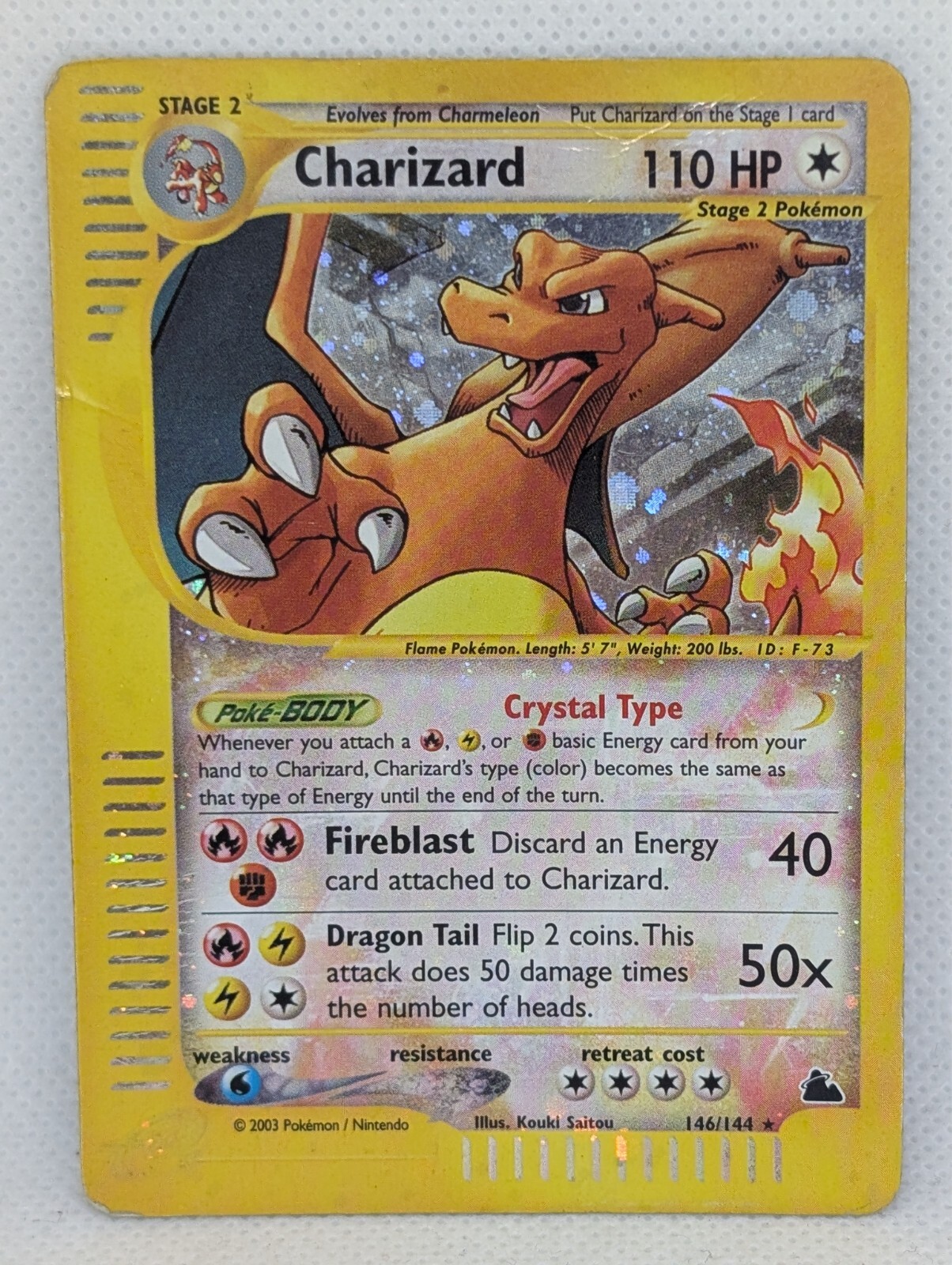
Then there are the Crystal cards. There are exactly nine in English, and they are numbered above the set total, which makes them trivial to spot.
| Crystal card | Set | Number | Raw, Sept 2026 |
|---|---|---|---|
| Charizard | Skyridge | 146/144 | ~$6,330 |
| Lugia | Aquapolis | 149/147 | ~$3,450 |
| Ho-Oh | Skyridge | 149/144 | ~$1,540 |
The other six are Kingdra 148/147 and Nidoking 150/147 from Aquapolis, and Celebi 145/144, Crobat 147/144, Golem 148/144 and Kabutops 150/144 from Skyridge. We have not checked current sold prices for those six, so look each one up rather than assuming it matches the three above.
Graded, the top of the list gets extreme. The Crystal Charizard reaches around $99,000 in a PSA 10, the Crystal Lugia around $81,130 and the Crystal Ho-Oh around $22,995.
The EX era is Gold Stars and then a long drop
The EX era ran from 2003 to 2007 and produced two things worth real money: Gold Star cards and a small number of Charizard prints. Everything else in the era is modest.
A Gold Star card has a tiny gold star printed straight after the Pokémon’s name, and the artwork bleeds across the whole card instead of sitting in a frame. There are 27 in English, spread across ten releases between November 2004 and March 2007. Contemporary estimates put the pull rate at roughly one per two booster boxes, about 1 in 72 packs, though official odds were never published.
| Gold Star | Set | Raw | PSA 10 |
|---|---|---|---|
| Rayquaza 107/107 | EX Deoxys | ~$8,390 | ~$365,750 |
| Espeon 16/17 | POP Series 5 | ~$5,550 | ~$56,120 |
| Umbreon 17/17 | POP Series 5 | ~$4,640 | ~$160,460 |
| Charizard 100/101 | EX Dragon Frontiers | ~$3,510 | ~$174,070 |
| Pikachu 104/110 | EX Holon Phantoms | ~$3,275 | — |
| Gyarados 102/110 | EX Holon Phantoms | ~$2,120 | — |
| Mewtwo 103/110 | EX Holon Phantoms | ~$1,813 | — |
Two things stand out there. Espeon costs more than Umbreon raw and roughly a third as much in a PSA 10, which is unusual enough to be worth flagging — both figures rest on very few sales a year, so treat either as an estimate rather than a market. And the drop below the Gold Stars is brutal: in EX Holon Phantoms the three Gold Stars sit at $1,800 and up, while the next card down the set list is a reverse holo Rayquaza at around $463.
The big “ex” cards — lowercase ex after the name, a fat HP number — are mostly worth $20 to $60. The exception is Charizard ex 105/112 from EX FireRed & LeafGreen, at around $526 raw and around $40,000 in a PSA 10.
Ordinary EX-era holos vary by where in the era they sit. The early sets held up better: EX Ruby & Sapphire holos such as Sceptile, Blaziken and Gardevoir run roughly $29 to $43. By the last set, EX Power Keepers, most holos are $6 to $16, with Charizard the standout at around $154.
Diamond & Pearl and Platinum are the thin stretch
This is where most people’s binders live, and it is the weakest part of the decade. Diamond & Pearl launched in 2007 into a much larger print run and a much smaller collecting culture than the sets on either side of it.
The base Diamond & Pearl set makes the point plainly. As of September 2026: Dusknoir around $3.99, Empoleon around $4, Manaphy around $4.55, Mismagius around $7, Rhyperior around $8.79, Electivire around $9.90. The most expensive holo in the whole set is Lucario at around $18. Great Encounters, a year later, is much the same: holos between about $5 and $21.
The value in this era is concentrated in the LV.X cards — the ones with “LV.X” after the name, a silver-bordered layout and a card number near the end of the set. Even those are uneven.
| LV.X card | Set | Raw | PSA 10 |
|---|---|---|---|
| Charizard G 143/147 | Supreme Victors | ~$266 | ~$19,406 |
| Rayquaza C 146/147 | Supreme Victors | ~$210 | — |
| Dialga 105/106 | Great Encounters | ~$110 | — |
| Palkia 106/106 | Great Encounters | ~$90 | — |
| Luxray GL 109 | Rising Rivals | ~$48 | ~$2,150 |
| Darkrai 104/106 | Great Encounters | ~$44 | — |
Supreme Victors also has three secret rares worth checking: Articuno 148, Moltres 149 and Zapdos 150, around $175 to $201 raw.
The honest part: most of a 2000s binder is bulk
If your binder is mainly Diamond & Pearl and Platinum holos, reverse holos and rares, the realistic total is a few dollars a card at best, and much of it counts as bulk. That is not a comment on how you kept them. Print runs got very large in the late 2000s, and demand for that period never recovered the way it did for 1999-2003.
Two disappointments come up constantly. Reverse holos from this era are almost never worth more than the normal version, and in Diamond & Pearl the reverse holo is frequently worth less. And an ex or LV.X card is not automatically valuable; most sit in the $10 to $50 range.
How to scan your binder in ten minutes
Work through it looking for four physical signals, in this order. This is faster than looking up cards one by one, and it will find essentially everything of consequence.
- A striped dot code strip along the bottom and left edge. That is an e-Card card, 2002-2003, and every holo in those sets is worth checking individually. Set them all aside.
- A card number higher than the set total — 146/144, 149/147, 148/147. In Aquapolis and Skyridge that means a Crystal card; in later sets it means a secret rare. Look every one of them up individually.
- A small gold star after the Pokémon’s name, with artwork covering the whole card. That is one of the 27 Gold Stars, and every one is worth looking up.
- “LV.X” after the name, silver border, high card number. Check the set: Supreme Victors and Platinum-era LV.X cards are the ones with a floor above $100.
Anything that fails all four tests is very likely a $1 to $20 card. Sort the rest by set rather than by Pokémon — the set symbol in the bottom corner tells you far more about price than the Pokémon does, and our set symbols guide covers how to read them.
Charizard is the exception to that advice. Every Charizard print from this decade is worth a look, from the Expedition holo at around $393 to the Power Keepers holo at around $154.
Is grading a 2000s card worth it?
For most of them, no. PSA’s Regular tier is $79.99 per card as of September 2026, with a $1,500 maximum insured value, and PSA’s Value tiers are currently listed as unavailable. A $10 Diamond & Pearl holo does not become a $90 card in a slab.
The maths only works at the top. Charizard G LV.X is the clearest example: around $266 raw, around $527 in a PSA 8, around $1,911 in a PSA 9 and around $19,406 in a PSA 10. That is a genuine reason to grade — but note the shape of it. A PSA 8 barely doubles your money after fees, so you are effectively betting on a 9 or better, and 2000s cards frequently have factory centring problems that cap them below that. Our guide to whether to grade walks through how to make that call before you pay.
For the Crystal cards and Gold Stars, grading is usually worth it if the card is genuinely clean, simply because the multiples are so large. For everything else in the decade, sell it raw.
If you would rather not work through several hundred cards yourself, send us photos. We will tell you which cards in your binder actually matter, which are bulk, and what we would pay for the lot — priced from recent sold comps, in writing, with no pressure to accept.
Common questions
- Are Pokémon cards from the 2000s worth anything?
- A small number of them are worth a great deal and most of them are worth very little. The chase cards of the era — the nine Crystal cards from Aquapolis and Skyridge, the 27 Gold Stars, and the best of the LV.X cards — run from several hundred dollars to six figures graded. Ordinary holos from Diamond & Pearl onward mostly sell for under $15 raw, and many sell for under $5.
- What are the crystal-looking Pokémon cards from 2003 worth?
- Those are Crystal cards, and there are only nine in English. As of September 2026 the Skyridge Crystal Charizard 146/144 sits around $6,330 raw, the Aquapolis Crystal Lugia 149/147 around $3,450, and the Skyridge Crystal Ho-Oh 149/144 around $1,540. The other six trade less often and should be checked individually. All nine are numbered above the set total, so a card reading 146/144 is one of them.
- How do I know if my card is a Gold Star card?
- A Gold Star card has a small gold star printed immediately after the Pokémon’s name at the top of the card, and the artwork is a full-bleed shiny illustration rather than the usual framed picture. There are 27 in English, released across ten sets between November 2004 and March 2007, and all of them are worth looking up. The best known run into the thousands raw: Rayquaza Gold Star from EX Deoxys is around $8,390 as of September 2026.
- Why are my Diamond and Pearl holo cards worth so little?
- Diamond & Pearl sets were printed in very large quantities during a period when far fewer people were putting cards away sealed, so surviving copies are plentiful. Base set Diamond & Pearl holos such as Dusknoir, Empoleon and Manaphy trade around $4 to $5 as of September 2026, and the most expensive holo in that set, Lucario, is about $18. This is not a reflection of how well you looked after them.